Advertise with my Blog Best Autos: Porsche
Showing posts with label Porsche. Show all posts

Wednesday, October 13, 2010

2010 speedART BTR-II 650 EVO New Design Porsche Sports Cars 997 Turbo

This is the SpeedART BTR II 650 EVO, the latest tuning package from the Porsche cars tuner SpeedART. The car is based on the 2010 Porsche 911 Turbo 3.8l with PDK-gearbox. SpeedART has come up with the new generation Bi-Turbo-Racer that possesses highly improved performance figures and an aerodynamic body kit.
2010 speedART BTR-II 650 EVO New Design Porsche Sports Cars 997 Turbo
The modification carried out by speedART has provided the 997 Turbo with custom wheel and suspension, custom body kit, as well as enhanced power. Power is enhanced by modifying the vehicle’s motronic to increase the power boost and mounted bigger VTG-turbo chargers, new sport exhaust with sport cats and twin tail pipes plus sport headers/manifolds, sport air filter and enlarged intercoolers. Due to these modifications, the Porsche 997 got an extra 150hp and 150 Nm.
2010 speedART BTR-II 650 EVO New Design Porsche Sports Cars 997 Turbo
To customize the wheel and suspension, speedART provides 997 Turbo with forged and weight reduced modular twin spoke wheels type „LSC FORGED = Light Spoke Competition“ in 8,5” and 12 x 20“ with 245/30 and 325/25 ZR20” in many different colors (price for complete set 6.640,- €). To harmonize, sportive and adjustable sport suspension in many different variations from type “street sport” up to or “race sport” incl. PASM function is available.
2010 speedART BTR-II 650 EVO New Design Porsche Sports Cars 997 Turbo
For the 997 Turbo exterior, speedART provides the speedART body kit “BTR-II EVO”, which consists of a new designed front bumper with spoiler lip and gun-metal frames for more downforce and better brake cooling (EVO-version), a new designed side skirts, rear diffuser and a rear spoiler with movable rear wing which is available in car color or original carbon. For the interior, speedART Individualize the new Porsche 997 Turbo with sport steering wheel for all models and with F1 shift paddles for PDK, sport seats with carbon shell in leather or alcantara, special leather or alcantara applications, and carbon interior parts in many colors as well.
2010 speedART BTR-II 650 EVO New Design Porsche Sports Cars 997 Turbo
Enhancing the 997 Turbo power, it is the speedART BTR-II 650 EVO (Bi-Turbo-Racer 2 generation with 650 hp), which is based on Porsche 997 Turbo with 3,8l engine and PDK shiftbox. The power increase of 150 hp and 150 nm consits of a modified motronic to enlarged the power boost in combination with bigger VTG-turbo chargers, a sport exhaust with sport cats and twin tail pipes plus sport headers/manifolds, sport air filter and enlarged intercoolers. With this power enhancement, speedART BTR-II 650 EVO Porsche 997 Turbo can accelerate from 0-100 km/h in 3,2 seconds and reach the top speed over 330 km/h.
2010 speedART BTR-II 650 EVO New Design Porsche Sports Cars 997 Turbo

Sunday, September 12, 2010

2010 Sportec SP580 Porsche 997 Turbo Facelift - Porsche Sports Car

The new Sportec 997 Turbo SP580 tuning kit is now available for the Porsche 997. Engineers from Sportec have boosted power from 500 PS (368 kW / 493 hp) to 580 PS (572 hp / 427 kW). If those numbers sound familiar, it is because the Swiss tuning firm developed a package that provided the same horsepower on the last SP580. However, the torque rating is reduced on this model, but is the same as the standard Porsche 997 turbo facelift.
Sportec SP580 Porsche 997 Turbo Facelift
Now, the new model sprints to 100 km/h in just 3.2 seconds, and to 200 km/h in 10.3 seconds. Top speed on the car is 323 km/h. The sprint times are faster than the old SP580, but the previous model topped out at 338 km/h (210 mph).
New forged 20-inch wheels have been developed for the car. However, the aero kit with front spoiler, big rear wing, and side skirts seems to be carried over from the pre-facelift kit.
With the new SP580 Sportec is once more prowling in the stomping ground of the super sports car. True to the sporty understatement Sportec the Porsche 997 turbo is a real leopard in wolf's clothing - this is ensured by the full 580 PS and powerful 650 Nm torque that can be had at just 1.950-5.000 revs.
Thus equipped the Sportec SP580 achieves the standard spring from 0 to 100 km/h in only 3.2 seconds. The occupants of the SP580 are catapulted from 0 to 200 km/h in a breathtaking 10.3 seconds. Only at 323 km/h does the revolution limiter put an end to this flush of speed.
Externally only the powerful Sportec Mono7 forged 20 inch wheels and the completely new aerodynamic package that holds true to the Sportec Motto "more substance, less style", suggest that beholder isn't looking at a mass production vehicle from Zuffenhausen. An aerodynamically optimised front spoiler, discrete side skirts along with a larger tail plane - as an option also to be had in carbon - both technically and optically complete the SP580. And if that wasn't enough the exterior mirrors and the air intakes can be had in matt carbon.
The aluminium pedals and foot supports as well as the bucket seats are all further signs of its sportiness. And for those who like it a little sportier there is a lowering set that brings the chassis around 20 millimetres nearer to the tarmac. For use on the race track Sportec offers a special PASM compatible super sports suspension that can be individually adjusted to suit every purpose and all race track conditions.

Saturday, September 11, 2010

2010 Porsche Sports Car 911 Tequipment

Porsche Tequipment has announced four new items for the 2010 Porsche Sport Car Classic 911. The new 2010 Porsche 911 Tequipment list includes sport classic wheels, a PDK steering wheel with gearshift paddles, an Aerokit Cup and a sport design front body panel. The new 2010 Porsche 911 Tequipment wheels come in 11.5 J x 19 ET 50 and are priced at Euro 5,569.20 including VAT. For the cars with tire pressure control the price is 5,866.70 EUR.
Porsche Sports Car 911 Tequipment
The 2010 Porsche 911 Tequipment three-spoke sports steering wheel with gearshift paddles is priced from Euro 940.10 and can be fitted to all versions of the 911, Boxster, Cayman, and Panamera. The 2010 Porsche 911 Tequipment Aerokit Cup is available for the coupe and is priced at Euro 4,522.00.
The Porsche 911 (pronounced as Nine Eleven, German: Neunelfer) is a 2-door sports coupe made by Porsche AG of Stuttgart, Germany. It has a distinctive design, rear engined and with independent rear suspension, an evolution of the swing axle on the Porsche 356.
Porsche Sports Cars Press Release:
Four new retrofit highlights from Dr. Ing. h.c. F. Porsche AG, Stuttgart, are dedicated entirely to the spirit of sporting performance. Particularly the 19-inch Sport Classic wheels in the unmistakable look of Porsche’s legendary Fuchs rims developed especially for the 911 Sport Car Classic built in a production run of just 250 units are an outstanding example of Porsche’s history and a striking design feature of the 911 Carrera.
Re-interpreted in individual style, the wheels in five-spoke design with the rim star painted black, the wheel hump in gloss-lathed finish, and the Porsche logo in colour on the wheel hub, are a genuine eye-catcher. Introduced by Porsche for the first time in 1966, these unique wheels are now making an outstanding come-back. The new wheels measure 8.5 J x 19 ET 55 and come together with tyres in 235/35 ZR 19 (front) and, respectively, 305/30 ZR 19 (rear) on all current all-wheel-drive models of the 911 Carrera and Targa as well as the 911 Turbo at an all-in price per set of Euro 5,569.20 including VAT (cars with tyre pressure control Euro 5,866.70).
Another particularly sporting feature is the three-spoke sports steering wheel with gearshift paddles for the PDK transmission already well known from the new 911 Turbo. Starting immediately, this unique leather steering wheel with gearshift paddles behind the right and left steering wheel spokes carried over from motorsport is available at a price of Euro 940.10 including VAT also for individual retrofitting on all versions of the 911, Boxster, Cayman, and Panamera with PDK and, starting in August 2010, on the new Cayenne with Tiptronic S.
The high-quality shift paddles are naturally made of metal. Through their stretched sickle shape, the gearshift paddles allow the driver to shift gears manually with perfect ease, from a wide range of individual holding positions on the steering wheel. The driver shifts up on the right and down on the left.
The newly developed Aerokit Cup available on all versions of the 911 Carrera Coupé shows a close and direct link to the fastest brand trophy in the world, the Porsche Mobil 1 Supercup. At the front of the car the most outstanding feature is the new apron with its striking trim bars in the centre air intake and the characteristic spoiler lip. At the rear the unique rear lid with the wing fitted in position takes up the highly successful design of the former model. It almost goes without saying that all components have been optimised in Porsche’s wind tunnel to improve both driving behaviour and aerodynamics.
Already available on new cars at a price of Euro 4,968.25 including VAT, the Aerokit Cup may now also be retrofitted on current models of the 911. In this case the price from Porsche Tequipment is Euro 4,522.00 including VAT, plus fitting and paintwork.
While so far the Aerokit with its particularly sporting look was not available to drivers of the 911 Cabriolet and Targa (997), the new, striking Sport Design front apron now closes this gap, with the spoiler lip matched aerodynamically to the regular rear spoiler. Naturally, the new front panel also fits on all other versions of the 911 Carrera and 911 Targa in the 997 model series. Finished in the same colour as the car itself, the front apron in Sport Design blends harmoniously with the overall contours and silhouette of the 911.
The Aerokit retails on new cars at a price of Euro 2,368.10 including VAT and is available from Porsche Exclusive. It may also be retrofitted individually by Porsche Tequipment at a price of Euro 2,159.85 including VAT, plus the cost of fitting and paintwork.

Friday, September 3, 2010

Carrera Facelift Porsche 911 Sports Car.


Carrera Facelift Porsche 911 Sports Car.


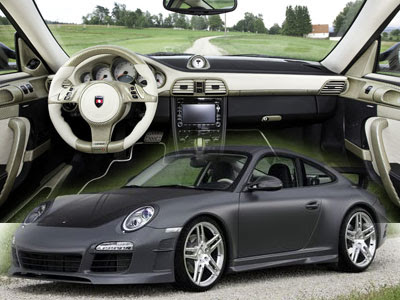
MANSORY Switzerland The High-quality refining programme for the new Porsche 911.
The company Mansory is situated in Bavaria and one of the top addresses for refining premium sports cars. Whether Bentley, Rolls-Royce, McLaren, Ferrari or Porsche – the refining specialist shows its technical talent for every automobile. The subsidiary company Mansory Switzerland AG, the in-house expert for Porsche cars, presents a comprehensive tuning programme for the model 911 from the recently revived Porsche Type 997 series at the Geneva Auto Salon 2009. This tuning programme mainly focuses on improvements concerning the aerodynamics, engine performance and handling of this sports car icon.
When developing the 911-programme, the Mansory engineers attached great importance to an individual design, but also aerodynamic efficiency. In order to save weight and guarantee highest quality standards, the body components are made of composite also, parts of the serial auto body are made of this resilient and inherently stable material. The core part of the body kit is a lift-reducing front mount in a sportive-dynamic look. In connection with the hood, the front apron offers various design possibilities. On the one hand, it forms the perfect symbiosis with the serial hood, as an especially designed inlay allows a seamless junction. And on the other hand, the apron can be combined with the Mansory carbon hood whose striking side beads demonstrate individuality and underline the sportive character of the modification. The rear apron is not less impressive: it accommodates the new four-pipe exhaust system and therefore renders a harmonic rear finish. The visual perfection of the aerodynamics pack is accomplished with the side skirts which also fulfil functional tasks. They significantly calm the air flow between both axles.
The power engines also profit from the comprehensive changes of the 911 engine range. But here, the engineers do not perform any excessive open-heart surgery, but only replace existing parts by modified proprietary developments. A new sport air filter and a new exhaust system come into operation. Especially the exhaust system renders an optimised exhaust gas flow. This enable the 911 to accelerate from 0 to 100 km/h even faster than the serial versions.
But the special highlight of the exhaust system is the integrated throttle system which - if desired - can also be operated by remote control and allows changing the sound scenery.
The refining specialist developed a forged wheel with an exclusive design which was tailor-made for Porsche requirements. The one-piece wheel with five double spokes measures 8.5 x 20 inches at the front and 12 x 20 inches the back. Not only its sportive look, but also its excellent manufacture makes it so impressive. The reduction of unsprung masses by the exceptional and elaborate production technology does not only lead to a shorter braking distance, but also improves the acceleration and the handling of the car. For best possible grip, Mansory uses Michelin Pilot Sport wheels sized 245/30 at the front and 325/25 at the rear. Moreover, the newly developed running gear which lowers the car´s centre of gravity by 30 millimetres also sets sportive accents.


Tuesday, August 3, 2010

2010 Porsche Sports Cars 911 GT3 R Hybrid

Known as the 2010 Porsche 911 GT3 R Hybrid, the model hints at new hybrid technology that Porsche Sports Cars will use in its motorsport ventures. According to Porsche, the 911 GT3 R Hybrid will be used as a study to gather information about how hybrid drive will behave under a racing environment and will also help the German automaker study how it can be applied to its road cars.
2010 Porsche 911 GT3 R Hybrid
During Porsche's press conference here at the Geneva Motor Show, most of our attention was understandably on the 918 Spyder Concept, but the German automaker had several other significant debuts. One was the 911 GT3 R Hybrid, Porsche's first race car to feature electric power sourced from a duo of motors that send power to a generator attached the flywheel. Like many hybrid production cars, the motors are charged whenever the brakes are applied, and the driver can use the extra power for 6-8 seconds for overtaking.
Exactly 110 years after Ferdinand Porsche developed the world's first car with hybrid drive, the Lohner Porsche Semper Vivus, Dr. Ing. h.c. F. Porsche AG, Stuttgart, is once again taking up this visionary drive concept in production-based GT racing: During the Geneva Motor Show, a Porsche Sports Cars 911 GT3 R with innovative hybrid drive is making its debut, opening up a new chapter in the history of Porsche with more than 20,000 wins in 45 years scored by the extremely successful Porsche 911 in racing trim.
Unlike a conventional battery-electric hybrid system the Porsche 911 GT3 R uses a flywheel system, which gathers kinetic energy under braking to power two electric-motors that are mounted in a single assembly and are connected to the front wheel. After each boost of charge, the two motors provide 6 to 8 second jolts of power. The extra power is engaged by pressing a button on the steering wheel, providing up to 161-hp to the front wheels, assisting the 911 GT3 R Hybrid’s 480-hp 4.0L inline-6 that powers the two rear-wheels.
The innovative hybrid technology featured in the car has been developed especially for racing, standing out significantly in its configuration and components from conventional hybrid systems. In this case, electrical front axle drive with two electric motors developing 60 kW each supplements the 480-bhp four-litre flat-six at the rear of the 911 GT3 R Hybrid. A further significant point is that instead of the usual batteries in a hybrid road car, an electrical flywheel power generator fitted in the interior next to the driver delivers energy to the electric motors.
The flywheel generator itself is an electric motor with its rotor spinning at speeds of up to 40,000 rpm, storing energy mechanically as rotation energy. The flywheel generator is charged whenever the driver applies the brakes, with the two electric motors reversing their function on the front axle and acting themselves as generators. Then, whenever necessary, that is when accelerating out of a bend or when overtaking, the driver is able to call up extra energy from the charged flywheel generator, the flywheel being slowed down electromagnetically in the generator mode and thus supplying up to 120 kW to the two electric motors at the front from its kinetic energy.
This additional power is available to the driver after each charge process for approximately 6 - 8 seconds. Energy formerly converted - and thus wasted - into heat upon every application of the brakes, is now highly efficiently converted into additional drive power.
Depending on racing conditions, hybrid drive is used in this case not only for extra power, but also to save fuel. This again increases the efficiency and, accordingly, the performance of the 911 GT3 R Hybrid, for example by reducing the weight of the tank or making pitstops less frequent.
After its debut in Geneva the 911 GT3 R Hybrid will be tested in long-distance races on the Nürburgring. The highlight of this test programme will be the 24 Hours on the Nordschleife of Nürburgring on May 15th and 16th. The focus is not on the 911 GT3 R Hybrid winning the race, but rather serving as a spearhead in technology and a 'racing laboratory' providing know-how on the subsequent use of hybrid technology in road-going sports cars.
The 911 GT3 R Hybrid is a perfect example of the Porsche Intelligent Performance philosophy, a principle to be found in every Porsche: More power on less fuel, more efficiency and lower CO2 emissions - on the track and on the road.

Monday, August 2, 2010

2010 New Porsche Sports Cars 911 GT3 at The Geneva

Stuttgart. Dr. Ing. h.c. F. Porsche AG, Stuttgart, is adding yet another new model to the second generation of the 911 model series: the new GT3 even more powerful, faster, and refined than its predecessor. In developing the most sporting and dynamic road-going 911 with a normal-aspiration power unit, Porsche has applied a wide range of know-how gained in motorsport. Indeed, this is precisely why the 2010 new Porsche 911 GT3 is truly impressive not only on the road, but also on the race track.
2010 Porsche Sports Cars 911 GT3
The 2010 new Porsche 911 GT3 is the latest evolution of an iconic sports car. Embodying the essence of more than 23,000 Porsche racing victories, the 911 GT3 is the ultimate integration of driver and car and arrives in the UK this autumn. The new 911 GT3 is making its world debut at the Geneva Motor Show on 3 March, with Europe-wide sales starting in May.
The Porsche 911 GT3 offers an even higher standard above all in two key areas: performance and driving dynamics. The proven six-cylinder naturally aspirated power unit now develops a maximum output of 435 hp (320 kW), up 20 hp over its predecessor. This results first and foremost from an increase in engine capacity by 200 cc to 3.8-litres and from improved cylinder head gas flow: now not only the intake, but for the first time also the exhaust camshafts, are adjusted by VarioCam.
A further important point is that, through its upgraded power and performance, the flat six 'boxer' engine also offers a significant increase in torque at medium engine speeds, a benefit of particular significance in everyday motoring. Clearly, this also means a further improvement in performance; the new Porsche 911 GT3 accelerates from a standstill to 62 mph (100 km/h) in 4.1 seconds and reaches 99 mph (160 km/h) in 8.2 seconds. Top speed is 194 mph.
The second emphasis in developing the Porsche 911 GT3 to an even higher standard was to further improve the car's driving dynamics. For the first time, the Porsche 911 GT3 comes with a particularly sporting variant of Porsche Stability Management (PSM), offering the facility to deactivate both Stability Control (SC) and Traction Control (TC) in separate steps. And to give the driver unrestricted, individual control over the driving dynamics of his car, these functions are not reactivated automatically even under the most extreme driving conditions, but only at the touch of a button.
The Porsche Active Suspension Management (PASM) fitted to the 911 GT3 has enabled Porsche engineers to make the springs and anti-roll bars stiffer yet again, thus ensuring even more precise handling in the PASM 'sports' mode. However, the PASM ensures appropriate ride comfort suitable for everyday use when in the 'normal' PASM mode. The Porsche 911 GT3 rides on new, lighter wheels in a racing-inspired design - with a centre locking nut - fitted with ultra-high performance (UHP) tyres. Tyre pressure monitoring is fitted as standard.
Making the car even more suitable for the race track, the new Porsche 911 GT3 will be available with the option of new and highly innovative Porsche Active Drivetrain Mount (PADM) engine mountings. These special engine mounts recognise a particularly sporting, race-like style of driving, making the normally 'elastic' engine mounts harder and particularly resistant. This retains all the motoring comfort of the GT3 in everyday traffic, while on the race track the effect of the mass forces coming from the engine is much reduced, particularly in fast bends and on winding tracks. Yet a further advantage is improved traction when accelerating from a standstill.
Another new feature is the optional lift system for the front axle which is able to increase the ground clearance of the car, at the touch of a button, for driving on bumpy surfaces or steep gradients - for example into an underground garage - by 30 millimetres (approx 1.2 inches).
The Euro base price of the new GT3 is Euro 98,100, in Germany the retail price including value-added tax and specific national features is Euro 116,947. In the USA the GT3 will be at the dealership in October at a price of USD 112,200 (MSRP without taxes).

Saturday, July 31, 2010

2013 Porsche Sports Cars 918 RSR Race Car

13-year-old WCF member and Porschephile, porschecarreragtmay6, has created some renderings of a Porsche 918 RSR race car. Based on the 918 Spyder concept, the pictures show a hardcore coupe, wearing some classic Porsche liveries, designed to compete in the GT1 class.
2013 Porsche Sports Cars 918 RSR Race Car
Although these renderings were created back in March, shortly after the 918 Spyder's surprise unveiling in Geneva, they provide a potential glimpse of a race spec 918 in the wake of recent reports that Porsche will field the 918 Spyder at the 24 Hours of Nurburgring in 2011.
The 2013 Porsche 918 RSR Race Car comes with 2 electric motors and a 500hp V8 from the “RS Spyder” LMP-2 car. The 918 RSR Race Car will drop the electric motors, but will retain the KERs and 500 hp V8. Since GT1 regulated no more than 600 hp, Porsche may remove air-restrictors from the engine to boost the output to 600hp.
As a refresher, the 918 Spyder concept featured a 368 kW (500 PS / 493 hp) V8 engine and three electric motors with a total of 160 kW (218 PS / 215 hp). Packing a combined 528 kW (718 PS / 708 hp), the Spyder sent power through a PDK dual-clutch gearbox (with an electric boost function) to an electric all-wheel drive system.
The 918 RSR model will race the same competitions as the classical 917 race car. It will drop the electric motors, but will retain the KERS and the 500hp V8. Since the GT1 regulates no more than 600hp, Porsche may remove air-restrictors from the engine to boost the output to 600hp. The "918 RSR" will be able to hit a top speed of 200mph and will make the 0 to 60 mph sprint in than 3.0 seconds.
It will feature a wider track, redesigned front and rear diffusers, as well as a fixed hard-top roof and a huge rear wing. The liveries on these images were created based off of the classic Porsche liveries and designed to compete in the GT1 class.
The Porsche 918 RSR Race Car will top in the 200mph range and will reach 62mph in less than 3.0 seconds, possibly 2.8 seconds. The weight will be around 1,240 kilos, 2,730 lbs.
The weight loss will comes from the loss of the batteries stripped interior and loss of amenities even more extensive use of carbon fiber and a reconstruction of body work.